The Irish Thread in America’s Story
Let’s be honest—you can’t tell the story of America without talking about the Irish. From the moment the first wave of Irish immigrants stepped off the boats in the 19th century, fleeing famine and seeking fortune, they began reshaping this country in ways that still echo today.
The Great Famine drove millions across the Atlantic, but they brought more than just empty stomachs and desperate hopes. They brought culture, grit, and an unshakeable determination to build something better. These weren’t just refugees—they were architects of a new American identity.
Look at the Irish impact on American life: in politics, you’ve got powerhouses like John F. Kennedy and Al Smith showing that an Irish Catholic could reach the highest echelons of power. In the arts, F. Scott Fitzgerald penned the Great American Novel while Irish music—from jigs to reels—became woven into the American soundtrack. Even St. Patrick’s Day evolved from an ethnic celebration into a nationwide party that brings everyone together, Irish or not.
Understanding Ronald Reagan’s Irish ancestry isn’t just about tracing family trees—it’s about understanding how one man’s heritage connected him to millions of Americans who shared that immigrant story. His roots reflect the struggles and triumphs of countless Irish families who planted themselves in American soil and grew something extraordinary.
The Gipper: From Tampico to the White House
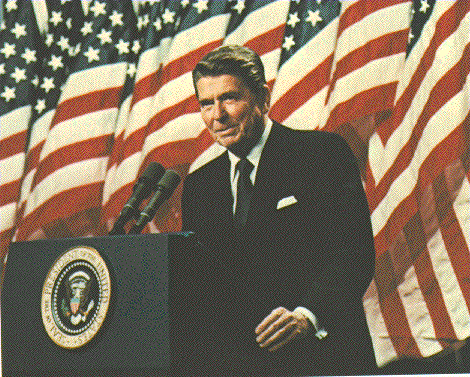
Ronald Wilson Reagan entered the world on February 6, 1911, in Tampico, Illinois—about as far from the Emerald Isle as you can get, but carrying Irish blood nonetheless. His father sold shoes, his mother kept the home, and young Reagan grew up in modest circumstances that would have been familiar to many Irish-American families of the era.
From early on, Reagan had that particular combination of charm and leadership that seemed almost bred in the bone. School activities, sports, community events—if there was a spotlight, Reagan found it. After graduating from Eureka College, he did what any Irish lad with charisma and good looks would do: he went to Hollywood.
His acting career was respectable enough—”Knute Rockne, All American” and “Kings Row” made him a recognizable face, if not quite a superstar. But more importantly, his time in entertainment taught him how to connect with audiences, how to tell a story, how to make people believe. These weren’t just acting skills—they were the tools that would later make him one of the most effective political communicators in American history.
The late 1940s saw Reagan’s politics shift rightward, influenced by his Hollywood experiences and his work with the Screen Actors Guild. His eloquence caught the attention of Republican leaders (because let’s face it, the Irish have always had a way with words), eventually leading to his election as Governor of California in 1967.
As governor, Reagan championed tax cuts and limited government—principles that would define his political career. His success in California catapulted him to the national stage, culminating in his election as the 40th President of the United States in 1980.
Reagan’s presidency was transformative: he took a hard line against the Soviet Union (eventually helping to end the Cold War), championed supply-side economics (whether you loved or hated “Reaganomics”), and reshaped the Republican Party into a movement that still bears his stamp today. His charisma and ability to connect with ordinary Americans—that Irish gift for making everyone feel like they’re having a conversation with an old friend—won him a landslide reelection in 1984.
Tracing the Reagan Line Back to Ireland
Here’s where it gets interesting: Ronald Reagan’s great-great-grandfather, Michael Reagan, emigrated from County Tipperary, Ireland (though some records also point to County Meath and Offaly—Irish record-keeping in the famine era wasn’t exactly meticulous) during the mid-19th century. The timing tells you everything you need to know: this was during the Great Famine, when Ireland was hemorrhaging population and families were making impossible choices between staying and starving or leaving and surviving.
Michael Reagan’s journey across the Atlantic was part of that massive Irish exodus, driven by desperation but fueled by hope. Like so many Irish immigrants, he was chasing the promise of America—land, opportunity, freedom, a chance to build something for future generations.
The family settled in Illinois, following a common pattern where Irish immigrants clustered in areas with work: cities with factories, rural areas needing farm labor, anywhere that offered a foothold in this new world. Reagan’s grandfather, John Edward Reagan, embraced American life while maintaining those Irish traditions that kept families connected to where they came from.
This genealogical journey isn’t just names and dates—it’s a story of resilience and reinvention. The Irish immigrant experience wasn’t merely about survival; it was about thriving, about contributing, about proving that given half a chance, Irish families could build American dynasties. And that’s exactly what the Reagans did.
Understanding this heritage provides crucial context for Reagan’s later life and politics. His family’s migration story embodied the classic American immigrant narrative: hardship overcome, opportunities seized, success achieved through determination and hard work. Reagan carried this story with him, consciously or not, throughout his political career.
Irish Values, American Leadership
Ronald Reagan’s Irish ancestry wasn’t just a biographical footnote—it fundamentally shaped who he was and how he led. Born into a family of Irish descent in 1911, Reagan grew up steeped in the values and customs that Irish families carried across the ocean and guarded like treasures.
Irish culture prizes certain things above almost all else: community, family loyalty, resilience in the face of adversity, and an optimism that borders on stubbornness. Sound familiar? These weren’t abstract concepts in the Reagan household—they were lived realities, the framework through which the family understood the world.
That Irish emphasis on community profoundly influenced Reagan’s approach to leadership. He believed in collective responsibility, in people working together toward common goals. His political philosophy balanced individual freedom with community support—you stand on your own two feet, but your neighbors are there when you stumble. That’s very Irish: independent but never alone.
Then there’s the legendary Irish optimism, that refusal to let circumstances dim your hope for a better tomorrow. Reagan’s sunny disposition, his ability to project confidence and possibility even during dark times—the Cold War, economic recessions, national crises—drew directly from this cultural wellspring. When Reagan said “It’s morning in America,” he was channeling generations of Irish people who greeted each dawn with determination despite everything history had thrown at them.
The Irish gift for storytelling also played a crucial role in Reagan’s success as a communicator. Irish culture has always valued the ability to tell a good story, to connect with people through narrative, to make complex ideas accessible through anecdotes and imagery. Reagan’s speeches weren’t just policy presentations—they were stories, carefully crafted to move people emotionally as well as intellectually. That’s pure Irish tradition, adapted for American politics.
His famous ability to connect with ordinary Americans? That’s Irish too. The best Irish leaders don’t stand apart from their communities—they’re part of them, comfortable in the pub (or the union hall, or the town square), talking with people rather than at them. Reagan had that gift in spades.
The Family Tree: Characters Who Made the Man
Digging into Ronald Reagan’s Irish family tree reveals some fascinating characters whose lives and choices shaped the trajectory of future generations.
Michael Reagan, Reagan’s great-great-grandfather, stands at the beginning of the American chapter. Emigrating from Ireland during the Great Famine, Michael embodied the courage it took to leave everything familiar and sail toward the unknown. He wasn’t fleeing just poverty—he was fleeing catastrophe, making the agonizing choice to abandon his homeland so his descendants might have a future.
Settling in Illinois, Michael worked as a farmer—backbreaking labor that many Irish immigrants took on because land represented something they’d rarely had access to back home: ownership, independence, the foundation for building wealth. His work ethic, born from necessity but sustained by pride, established a family standard that would echo through generations.
Then there’s Mary Reagan (née Fitzpatrick), Reagan’s great-grandmother. Born in Ireland before emigrating, Mary married Michael and became the keeper of family traditions. In immigrant families, women often carried the cultural flame, ensuring children learned the stories, the customs, the values that connected them to their heritage. Mary made sure the Reagan family remained Irish even as they became American.
Reagan’s grandfather, John Edward Reagan, represents the next evolution: fully American but still connected to Irish roots. John was known for his intelligence and community leadership, becoming involved in local politics and civic affairs. His engagement with public life likely planted the first seeds of political involvement in the family line—a legacy his famous grandson would eventually fulfill on the grandest stage.
These weren’t just Reagan’s ancestors—they were archetypes of the Irish-American experience. Their stories of sacrifice, hard work, and gradual advancement represent millions of similar stories playing out across America, each family writing its own version of the immigrant success narrative.
How Irish Roots Shaped Reagan’s Politics
Here’s something that doesn’t get discussed enough: Ronald Reagan’s Irish heritage didn’t just influence his personality—it shaped his actual political philosophy and policy decisions.
Reagan’s Irish lineage instilled values like resilience, community support, and family loyalty. These attributes directly informed his approach to governance. Take his social policies: Reagan championed individual responsibility (very Irish—you’re expected to pull your own weight) while also supporting safety nets for the disadvantaged (also very Irish—you help those who can’t help themselves). This wasn’t contradictory; it mirrored traditional Irish values that balanced self-reliance with communal support.
His foreign policy also bore Irish fingerprints, particularly regarding the United Kingdom and Ireland. Reagan’s interest in the Northern Ireland peace process, his diplomatic initiatives toward conflict resolution—these reflected an understanding shaped by Irish historical narratives of struggle and the yearning for peace. He could frame foreign policy through the lens of shared values and historical experience because that history was, in a sense, his own.
Immigration reform during Reagan’s presidency revealed perhaps the clearest influence of his ancestral background. His support for pathways to citizenship for undocumented immigrants wasn’t just political calculation—it reflected an empathetic recognition of the immigrant experience. Reagan understood viscerally what it meant to be an outsider seeking opportunity in America because his own family’s story started exactly that way.
This empathy extended to his rhetoric about America as a “shining city on a hill”—a beacon for immigrants worldwide. Reagan wasn’t just echoing biblical imagery; he was articulating the promise that had drawn his own ancestors across the Atlantic. His politics of hope and opportunity drew directly from the Irish immigrant narrative of transformation and advancement.
Reagan and the Irish Question
Ronald Reagan’s connection to Ireland extended beyond genealogy—it became a significant element of his foreign policy and diplomatic relationships during the 1980s.
The Northern Ireland conflict—”The Troubles”—presented a complex challenge involving nationalist and unionist factions in a cycle of violence that had persisted for decades. Reagan recognized that a peaceful resolution required dialogue and compromise, not just security measures. His administration actively supported the Anglo-Irish Agreement of 1985, a pivotal accord that improved cooperation between the British government and the Irish Republic regarding Northern Ireland’s governance.
This wasn’t just diplomatic box-checking. Reagan’s Irish ancestry gave him a personal stake in seeing peace in Ireland. He understood the historical grievances, the deep-seated divisions, the generational trauma that fueled the conflict. When he advocated for peace, it wasn’t abstract—it was personal.
Reagan cultivated strong relationships with Irish political leaders during his presidency. Taoiseach (Prime Minister) Garret FitzGerald was a frequent White House guest, and these meetings weren’t merely ceremonial. They represented direct dialogue on critical issues, demonstrating America’s commitment to Irish interests and stability.
Reagan’s charm and genuine affection for Irish culture won him enormous goodwill among the Irish people, both in Ireland and in Irish-American communities. He didn’t just acknowledge his heritage—he celebrated it, making it clear that being of Irish descent was something to be proud of. This personal connection bolstered support for his administration’s Irish policies and strengthened the broader U.S.-Ireland relationship.
His awareness of Ireland’s struggles and triumphs, coupled with his democratic ideals, shaped his approach to international relations regarding Ireland. Reagan’s presidency represented a pivotal era in U.S.-Ireland relations, demonstrating how a leader’s personal heritage can influence diplomatic priorities and international engagement.
The Cultural Legacy: How Reagan Made Irish Cool Again
Ronald Reagan’s Irish ancestry became a significant part of his public image and left an indelible mark on American popular culture. Reagan himself never hid his Irish roots—he celebrated them, making his heritage part of the larger narrative of his American success story.
In films and documentaries about Reagan’s life, his Irish background is frequently highlighted as foundational to his identity. Portrayals often emphasize his immigrant forebears who fled the Great Famine, framing Reagan as the ultimate embodiment of the American Dream—a descendant of desperate refugees who became the most powerful man in the world. This narrative is powerful precisely because it’s true, and it resonates with anyone whose family came to America seeking better opportunities.
Books about Reagan regularly reference his Irish lineage as a lens for understanding his character and leadership style. Authors explore how values like loyalty, resilience, and optimism—hallmarks of Irish culture—manifested in Reagan’s political philosophy and governing approach. This isn’t just cultural analysis; it’s an acknowledgment that heritage genuinely shapes perspective and priorities.
The media played a crucial role in cementing Reagan’s Irish identity in the public consciousness. News features, biographical profiles, and even St. Patrick’s Day celebrations at the White House highlighted his ancestral connections, making them part of how Americans understood Reagan as a person and as a president.
This emphasis on heritage also sparked broader discussions about the Anglo-Irish relationship and immigration’s role in American success. Reagan became a symbol of immigrant achievement, proof that the Irish—once looked down upon, discriminated against, considered inferior by nativist Americans—could not only succeed but lead the entire nation.
The legacy continues today. Reagan’s Irish ancestry remains a touchpoint in discussions about immigration, cultural identity, and the American Dream. His story validates Irish heritage while also connecting it to the broader immigrant narrative that defines America.
The Lasting Impact: Why Reagan’s Roots Still Matter
Exploring Ronald Reagan’s Irish ancestry reveals something profound about how heritage shapes leadership and national identity. Reagan’s roots, traceable to counties like Tipperary and Offaly in Ireland, provided more than just genealogical interest—they offered a cultural foundation that influenced his perspectives on governance, community, and America’s role in the world.
The values Reagan inherited from his Irish lineage—resilience, optimism, community spirit—weren’t just personality traits; they were governing principles. As president, Reagan championed the immigrant story, recognizing that diversity and varied backgrounds strengthen rather than weaken America. This wasn’t abstract philosophy; it came from his family’s lived experience.
Reagan’s embrace of his heritage resonated powerfully with Irish-Americans and immigrants from all backgrounds. His presidency marked a moment when Irish cultural identity was not just acknowledged but celebrated at the highest levels of American government. This validation mattered, especially for a community that had faced discrimination and prejudice in earlier American eras.
The broader lesson extends beyond Reagan himself. His story demonstrates how immigrant backgrounds forge political identities and shape policy priorities. Leaders carry their heritage with them—consciously or unconsciously—and it influences how they see the world and what they fight for.
As discussions about immigration and cultural identity continue in contemporary America, Reagan’s Irish ancestry serves as a reminder of fundamental truths: immigrants have always been essential to American success, cultural heritage enriches rather than divides, and the American Dream isn’t abstract mythology—it’s the lived experience of families like the Reagans who came here with nothing and built everything.
Reagan’s legacy isn’t just about his presidency or his policies—it’s about what his success represented: proof that in America, where you come from matters less than where you’re going, but also that remembering where you come from can guide you toward where you need to be.
The Final Word
Ronald Reagan‘s Irish heritage wasn’t window dressing or convenient political branding—it was integral to who he was and how he led. From his great-great-grandfather Michael fleeing famine in Ireland to Ronald himself standing in the Oval Office, the Reagan family story encapsulates the Irish-American experience in all its struggle and triumph.
The values that Irish culture prizes—community, resilience, optimism, loyalty—weren’t just abstract concepts Reagan referenced in speeches. They were the operating system of his leadership, visible in his policies, his communication style, his vision for America. When Reagan talked about a “shining city on a hill,” he was describing the same beacon that had drawn his ancestors across the Atlantic generations earlier.
Reagan’s success validated something important: that Irish heritage, once derided and discriminated against, was something to celebrate. He made being Irish-American presidential, literally. Every St. Patrick’s Day celebration at the White House, every reference to his immigrant roots, every policy informed by empathy for newcomers—these were assertions that Irish culture had a place at the very pinnacle of American power.
The lasting impact goes beyond Reagan himself. His story illuminates how heritage shapes perspective, how cultural identity influences leadership, and how the immigrant experience enriches American democracy. Future leaders carrying their own ancestral legacies can look to Reagan as proof that embracing your roots while serving your country aren’t contradictory impulses—they’re complementary.
In our current era, when debates about immigration and identity often generate more heat than light, Reagan’s story offers useful perspective. The Irish came to America desperate and were met with prejudice. Within a few generations, one of their descendants was leading the free world. That’s not just a nice story—it’s the American story, repeated across countless ethnicities and backgrounds.
So here’s to Ronald Reagan—an Illinois boy with Tipperary blood, a president who never forgot where his family came from, and a reminder that the best leaders draw strength from their roots while reaching toward the future.
Sláinte to that, and to all the immigrants who believed America’s promise and made it real for themselves and their children.
Shop new arrivals
-

“Get Lucked Up” Unisex T-Shirt – Shamrock Shenanigans
Price range: $19.99 through $25.99 -

“Leprechaun Cat” Unisex T-Shirt – Purrfectly Lucky
Price range: $19.99 through $25.99 -

4-Leaf Clover USA Flag Unisex T-Shirt – Irish American Pride Tee in Green for Heritage & Gifting
Price range: $22.99 through $27.89 -

American Grown with Irish Roots Unisex T-Shirt – USA & Ireland Flag Heritage Tee
Price range: $22.99 through $27.89 -

Biting Lip Irish Pop Art Unisex T-Shirt – Sexy Green Shamrock Tee with Glitter Vibes
Price range: $22.99 through $27.89